Estamos en Dialnet
2026-08-07
Nos complace formar parte de DIALNET, portal de la Universidad de la Rioja, España.
Read more about Estamos en Dialnet

Ethos Journal, (previously named Ethos Venezolana) is a biannual scientific publication of recognized scientific and humanistic impact, national and international, whose purpose is to disseminate works in various modalities: articles, essays, monographs, reviews, among others, whose contributions constitute a necessary means to consolidate research and transmission of knowledge in the field of sciences: Sociology, Economics, Anthropology, Philosophy, Engineering, Education, Law, Management, New Technologies and other areas related to factual and formal sciences. Likewise, Ethos is a journal refereed by experts with extensive experience in their respective research areas, under the double-blind system, which guarantees the strict confidentiality inherent to the evaluation and ruling process. It is dedicated to stimulating scientific and humanistic research in the social context that serves as its environment, especially in Latin America and the Caribbean.
The purpose of Ethos Journal is to promote rapprochement between scientific and technological communities around the world, with emphasis on America, in order to become a permanent discussion forum, in which professors, national and international researchers, as well as Also, undergraduate and graduate students, can disseminate their scientific findings from different paradigms, theoretical and epistemological approaches.
Welcome to our portal, our scientific productions are freely accessible, we invite you to send your preliminary manuscripts to be reviewed by a group of experts. You can download the rules and publication format in the section corresponding to the authors.
Email: revistaethos@uniojeda.edu.ve // revistaethosvenezolana@gmail.com
Nos complace formar parte de DIALNET, portal de la Universidad de la Rioja, España.
Read more about Estamos en Dialnet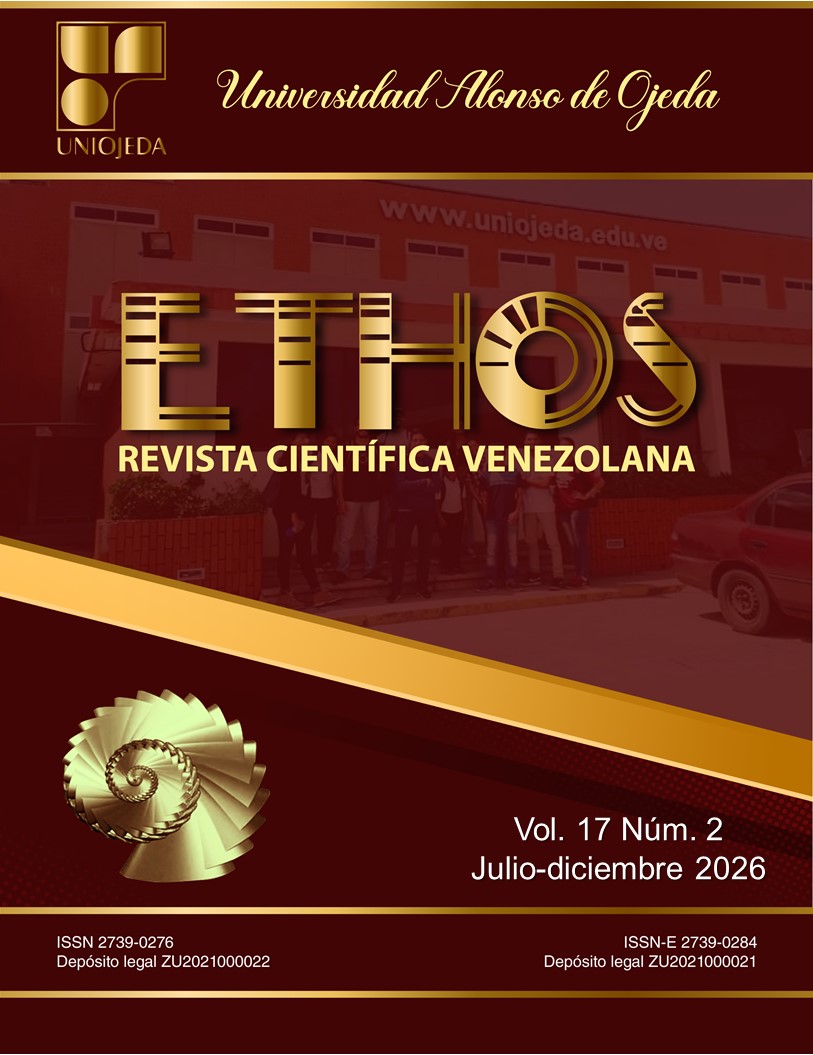
This issue is based on a fundamental theoretical premise: the urgent need to develop multidimensional approaches aimed at understanding, interpreting, and managing organizational reality through critical and transformative perspectives. In response to the traditional fragmentation of corporate knowledge, the scholarly contributions gathered here engage in an active dialogue aimed at constructing new organizational rationalities. These proposals go beyond mere Taylorist technical or instrumental efficiency; by incorporating—with equal emphasis—ethical, technological, pedagogical, and social dimensions, they create a space for discussion where academic theory is harmoniously integrated with practice, outlining horizons for action that are in tune with contemporary demands.
Nos complace formar parte de DIALNET, portal de la Universidad de la Rioja, España.
Revista Ethos is edited by
Universidad Alonso de Ojeda



© Update 2025. Alonso de Ojeda University